
“Well-being” is one of the safest words in Social Value.
It appears everywhere. It offends no one. It sounds so positive, it’s like the girl next door version of mental health.
It’s also often completely undefined.
After more than two decades working in mental health, across schools, communities and organisations — and applying trauma-informed practice in real-world settings, I’ve learned this:
If you cannot define well-being in observable terms, you are not delivering it.
You’re describing it.
And description is not impact.
Well-being Is Not an Activity
In tenders, well-being is often attached to activity:
- A workshop.
- A mural.
- A mindfulness session.
- A volunteering day.
- A celebration event.
These may be meaningful experiences.
But they’re outputs.
Well-being is a condition
It shows up in:
- Regulation.
- Psychological safety.
- Participation.
- Agency.
- Confidence.
- Belonging.
- Sustained engagement.
If those do not shift, well-being has not shifted.
Belonging Is the Mechanism
In my experience, well-being and belonging are inseparable.
You cannot feel well in a space where you don’t feel you belong.
When young people disengage, it’s rarely because they lack potential. When communities resist development, it’s rarely because they resist change. When staff burn out, it’s rarely because they lack resilience.
More often, the conditions for belonging are missing.
And that absence is measurable:
- Attendance drops.
- Participation declines.
- Behaviour escalates.
- Staff turnover increases.
- Volunteer days feel transactional rather than relational.
If Social Value is serious about well-being, it must be serious about belonging.
A Short Case Example
On a recent place-based project connected to a new development, we worked with young people who were labelled “hard to engage”.
Initial attendance was inconsistent. Confidence was low and contributions were minimal.
We did not begin with output.
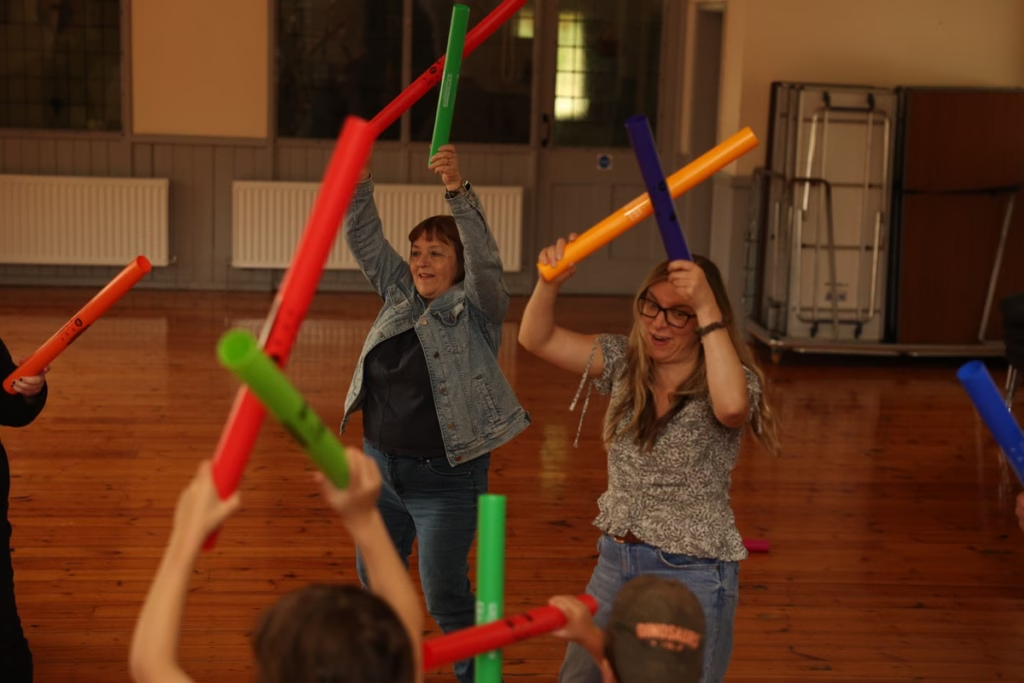
We began with rhythm: shared, embodied, structured. Simple call-and-response patterns. Predictable frameworks. Clear agency within boundaries.
Within weeks:
- Attendance stabilised.
- Verbal contribution increased.
- Peer encouragement emerged.
- Young people began shaping the creative direction themselves.
By the final phase, the work was not something being delivered to them. It was being led by them.
That shift from passive attendance to ownership is measurable well-being.
It shows up in behaviour, voice, and sustained participation.
The Arts as a Structured Framework
The arts are often spoken about romantically. I prefer precision.
When designed properly, arts-led Social Value programmes create the conditions for well-being:
Shared rhythm builds co-regulation. Collective creation builds agency. Embodied participation builds psychological safety. Visible output builds ownership. Repeatable structures build sustainability.
This is not about “creative enrichment”.
It’s about nervous systems settling enough for people to think, contribute and collaborate.
Without regulation, there is no participation. Without participation, there is no belonging. Without belonging, well-being doesn’t hold.
Volunteer Days Are Not One-Way
This is particularly important when organisations design volunteering into Social Value commitments.
If well-being is the goal, volunteer days cannot be one-directional acts of service.
They must be democratic learning spaces.
When structured well, they create:
- Mutual regulation.
- Cross-sector understanding.
- Shared authorship.
- Psychological safety across hierarchy.
- A sense of collective ownership.
Those conditions are not only necessary for communities.
They are necessary for staff to do their best work and improve their own well-being.
Often there is a big separation from Social Value activities and an organisation’s EDI policies.
A joined up approach that supports staff as well as communities but only benefits the organisation but I’d argue, makes the Social value engagement more authentic and impactful for everyone.
Social Value Is Maturing. Our Language Must Too.
Frameworks are tightening. Reporting expectations are rising. Evidence matters.
If we continue to use well-being as a vague aspiration, we weaken our own credibility.
If we define it clearly, as regulation, belonging, agency and participation, we strengthen it.
Well-being underpins:
- Educational attainment.
- Skills development.
- Employability.
- Workforce retention.
- Community cohesion.
The organisations who understand this are no longer commissioning isolated activities. They are commissioning designed conditions: structured, trauma-informed, measurable environments where belonging can emerge and be tracked over time.
That’s where arts-led Social Value moves from decorative to strategic.
And that is where it becomes credible.
Well-being in Social Value doesn’t need to be poetic.
It needs to be intentional.
It needs to be designed.
And it needs to leave evidence behind.